Joko Baucal
Feb 23, 2026
Mobile App Monetization in 2026: Revenue Growth Without Install Growth
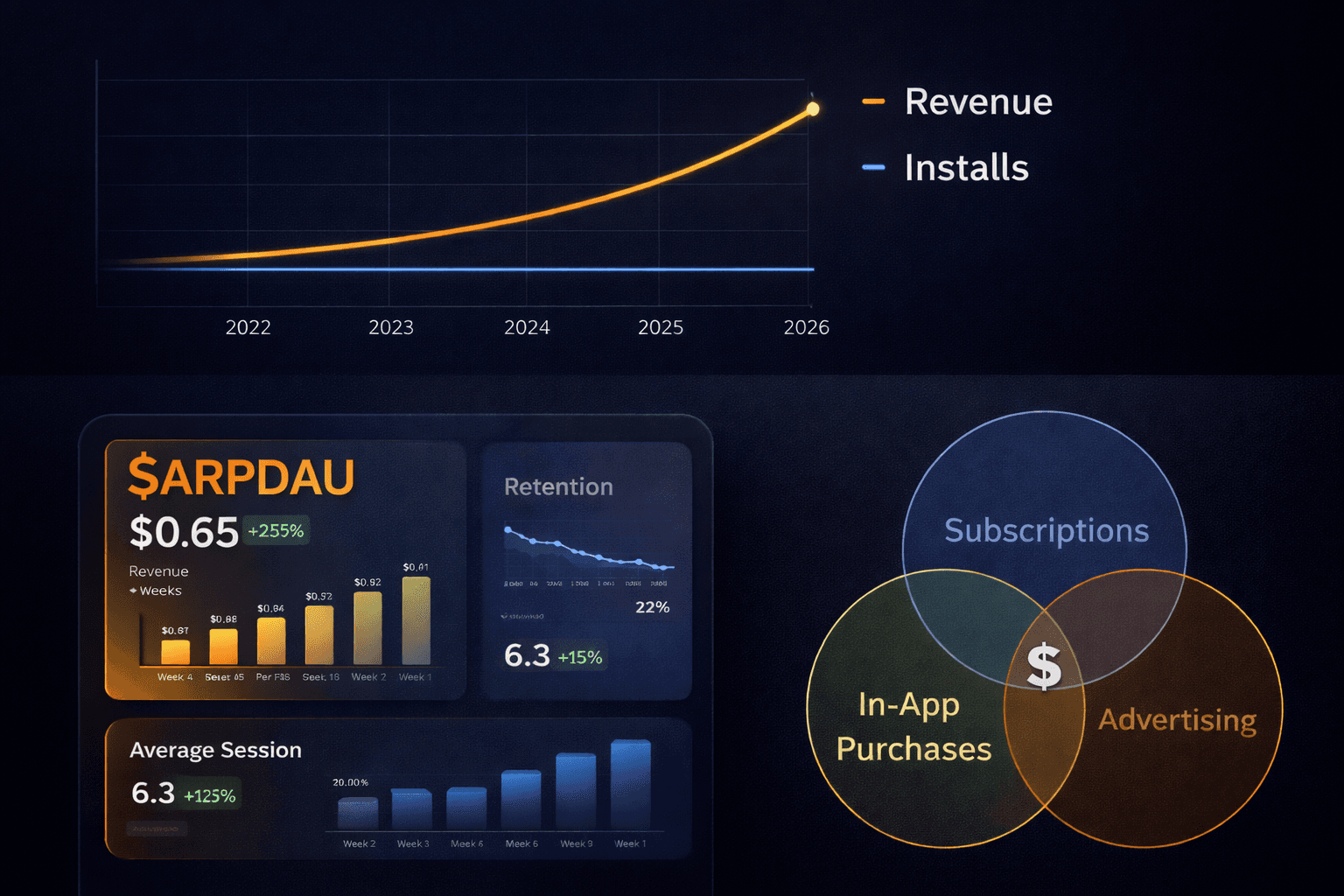
The mobile app market has entered a new phase. Global downloads are no longer expanding at the pace seen during the pandemic years. In many mature markets, installs are flat year over year. Some categories have even started to decline.
Yet overall app revenue continues to grow.
This divergence between downloads and spending marks one of the most important structural shifts in the mobile economy in recent years.
A Mature Install Market
The slowdown in download growth is not surprising. Smartphone penetration is high in most developed markets. App stores are saturated. User attention is concentrated in a limited number of dominant platforms.
For publishers, this means that organic install growth is harder to achieve. Paid acquisition remains possible, but costs are elevated and competition is intense. The era when scale alone could drive revenue expansion is largely over.
Install volume is stabilizing. The market is maturing.
Revenue Is Growing for a Different Reason
While downloads are flat, in-app spending is increasing. This growth is not driven by new users entering the ecosystem, but by better monetization of existing ones.
Several factors explain this trend:
Improved subscription models
More refined paywall strategies
Stronger onboarding flows
Smarter ad monetization setups
Better segmentation of users by value
Publishers are extracting more revenue per active user. Instead of expanding the top of the funnel, they are optimizing what happens after installation.
ARPDAU and LTV Become Central Metrics
In this environment, performance is no longer measured primarily by install growth. The key metrics shift toward:
ARPDAU (Average Revenue Per Daily Active User)
Retention rates
Session depth
Lifetime value (LTV)
When downloads stagnate, revenue growth must come from improving these variables.
A small uplift in ARPDAU or retention can have a meaningful impact on total revenue, especially at scale. Publishers that focus on incremental efficiency gains often outperform those relying on aggressive acquisition spending.
Retention Is the New Growth Lever
Retention now plays a larger role than ever. If users stay longer, they generate more ad impressions, more subscription renewals, and more in-app purchases.
In a flat install market, retention acts as a multiplier. The longer a user remains active, the more stable and predictable revenue becomes.
This dynamic also increases the importance of product quality. Monetization systems that harm early experience may deliver short-term gains, but they weaken long-term performance.
Monetization Strategy Is Evolving
The shift is visible across both gaming and non-gaming categories.
Many publishers are moving toward hybrid models that combine:
Subscription revenue
In-app purchases
Advertising
This diversification reduces risk. High-value users can be monetized through subscriptions or premium features, while non-paying users generate revenue through ads.
The goal is not to increase monetization pressure, but to improve monetization efficiency.
A Structural Change, Not a Temporary Trend
The current situation does not appear cyclical. It reflects a structural transformation in the mobile market.
User acquisition alone is no longer a reliable growth engine. Monetization design, user experience, and behavioral optimization have become equally important.
In 2026, the companies outperforming the market are not necessarily those buying the most installs. They are the ones improving revenue per user through disciplined experimentation and long-term retention strategy.
As downloads stabilize, value creation inside the product becomes the primary source of growth.
For app publishers, the message is clear: growth has not disappeared. It has shifted from scale to efficiency and don't underestimate power of Ads :)